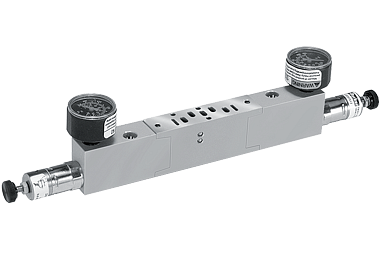




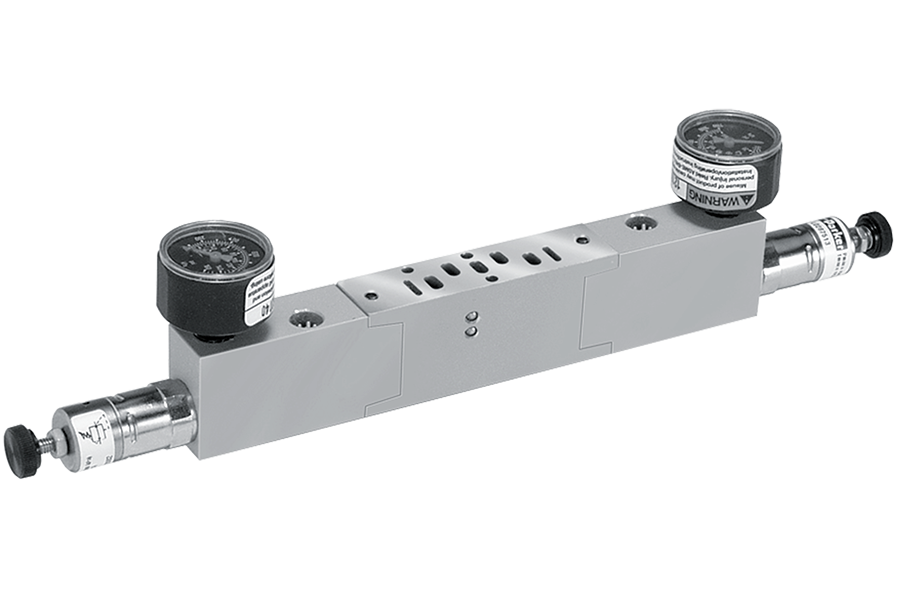
Interposed Regulators For ISO Series Valves
 Product Catalog - ISO 5599-2
Product Catalog - ISO 5599-1
Product Catalog - ISO 5599-2
Product Catalog - ISO 5599-1
- Controls the pressure through the base-mounted valve
- Single & double pressure regulators available
loading...
loading...
Product Overview
The ROSS Controls Interposed Regulators are sandwich-style pressure regulating modules that mount between a base-mounted directional control valve and its manifold or sub-base station, providing independent regulated pressure at one or both actuator ports (Port 2 and Port 4) without any additional external piping. These interposed regulators are available for ISO 5599-2 W65 Series valves in ISO Sizes 1, 2, and 3, and for ANSI and SAE valve platforms.
Single regulator configurations (models 965N91, 967N91, 969N91) deliver a common regulated supply pressure to both outlet ports of the valve. Double regulator configurations (models 966N91, 968N91, 970N91) provide fully independent pressure adjustment at Port 2 and Port 4, enabling differential pressure control on opposite ends of a double-acting pneumatic cylinder to achieve asymmetric force or speed profiles.
The interposed regulator is configured for internal pilot as standard: system pressure at manifold Port 1 feeds through the regulator to supply the valve pilot. When used with double regulators, valves must be ordered as external pilot to maintain correct pilot pressure routing. Gauge options from 1-30 psig to 5-125 psig are selectable per port at time of order, and a pressure gauge kit (RPS5651160P for ISO 15407 sizes) is available for field-installation of gauges.
For machine builders and process engineers specifying ISO-standard pneumatic manifold systems, Interposed Regulators provide a clean, modular, and standards-compliant approach to per-station pressure zoning that eliminates external regulator mounting hardware, reduces installation footprint, and simplifies manifold assembly.
Key Engineering Features
- Sandwich Construction Between Valve and Manifold - The interposed regulator mounts directly between the valve body and the manifold or sub-base station using the valve's own mounting hardware, requiring no additional external piping or bracket mounting.
- Single and Double Regulator Options - Single regulators provide a common regulated pressure at both outlet ports. Double regulators provide fully independent pressure adjustment at Port 2 and Port 4, enabling differential force or speed control on double-acting cylinders.
- ISO Size 1, 2, and 3 Coverage - Available for ISO 5599-2 W65 Series valves in all three standard ISO sizes (Size 1 through Size 3), ensuring system-level compatibility across complete manifold assemblies.
- Multiple Pressure Range Options - Selectable pressure ranges at the time of order include 1-30 psig, 2-60 psig, and 5-125 psig configurations, covering low-force actuator applications through standard industrial cylinder circuits.
- Optional Integrated Pressure Gauges - Each port regulator position can be ordered with or without an integrated pressure gauge for real-time monitoring of regulated pressure at each valve station without external instrumentation.
- Internal Pilot Configuration Standard - Standard configuration uses manifold Port 1 system pressure to feed the interposed regulator and supply the valve pilot, simplifying installation without external pilot supply connections.
- Common and Independent Pressure Modes - Common pressure regulator mode delivers the same regulated pressure to both ports from a single adjustment. Independent mode allows separate adjustment of Port 2 and Port 4 regulators for asymmetric cylinder force applications.
- No Additional Piping Required - The sandwiched installation captures all pressure paths within the station footprint, eliminating field-fabricated tubing runs that would otherwise be required for per-cylinder pressure regulation.
Technical Specifications
General Specifications
| Parameter | Specification |
| Compatible Valve Series | ISO 5599-2 W65 Series (Sizes 1, 2, 3); ANSI W70/W74 Series; SAE 80/84 Series (Sizes 125, 250); ISO 5599-1 W60/W64 Series |
| Configuration Options | Single (common pressure); Double (independent Port 2 and Port 4 pressure) |
| Pressure Range - Low | 1-30 psig (available with or without integrated gauge) |
| Pressure Range - Mid | 2-60 psig (available with or without integrated gauge) |
| Pressure Range - High | 5-125 psig (available with or without integrated gauge) |
| Pilot Supply | Internal pilot standard (manifold Port 1 feeds pilot); external pilot required for double regulator applications |
| Mounting | Sandwich between valve body and manifold/sub-base station; uses valve mounting hardware |
| Flow Media | Filtered compressed air |
| Maximum Inlet Pressure | 150 psig (10 bar) - from host manifold system pressure |
| Adjustment | Both adjustment screws located on the Port 12 end of the unit |
Certifications & Compliance
| Certification/Standard | Detail |
| Standards Compliance | Compatible with ISO 5599-2 (W65 Series), ISO 5599-1 (W60/W64 Series), ISO 15407-1, and ISO 15407-2 (W66 Series) base-mounted valve platforms. |
| CE Marking | Host ISO valve platforms carrying CE marking maintain compliance when used with interposed accessories installed per ROSS installation instructions. |
Typical Applications & Industries
Automotive Assembly and Body Shop
- Independent pressure control at individual welding fixture clamp stations on automotive body assembly lines, where clamping force at Port 2 must be set higher than the part seating force at Port 4 to avoid part distortion during weld sequences.
- Per-station pressure zoning on multi-valve manifolds serving assembly transfer lines, where different pneumatic actuators in the same manifold require different force levels to handle components of varying mass without separate external regulators for each circuit.
- Controlling extend force and retract force independently on dual-rod pneumatic cylinders used in door panel assembly jigs, enabling precise control of sealing pressure without over-clamping fragile trim components.
Packaging and Converting Machinery
- Asymmetric pressure control on horizontal form-fill-seal machine jaw cylinders, where sealing jaw closing force must exceed opening force to prevent jaw bounce while minimizing retract shock loading on carriage mechanisms.
- Per-station pressure control on multi-valve cartoning machine manifolds, providing independent pressure tuning for erecting, folding, and gluing stations operating from a common manifold air supply.
- Controlling pilot pressure independently from actuator pressure at individual manifold stations on palletizing systems where heavy loads require high extend force but controlled retract forces to prevent product damage.
Machine Tool and Metalworking
- Independent Port 2 / Port 4 pressure regulation on pneumatic work-holding fixtures for CNC machining centers, enabling separate control of clamping force and part ejection force from the same valve station.
- Differential pressure control on pneumatic counterbalance and overrun systems for vertical axis machine tools, where gravity-compensating extend pressure must be set independently from rapid-retract pressure.
Press Control and Metal Forming
- Per-station independent pressure control on multi-valve press clutch/brake manifolds, enabling isolated pressure adjustment for each press in a tandem line without disturbing common manifold supply pressure.
- Die cushion circuit pressure regulation on mechanical presses using ISO-standard valve manifolds, providing draw force control independent of blank holder pressure from the same manifold station.
Food and Beverage Processing
- Gentle product handling applications on conveyor stop gates and diverters where low-force contact pressure must be independently controlled from the cylinder retract force to prevent product damage at varying throughput speeds.
- Per-station pressure control on multi-valve filling and capping machine manifolds, accommodating different pressure requirements for cap pressing, torquing, and container indexing functions within a single manifold assembly.
Material Handling and Palletizing
- Independent pressure control on clamp cylinder extend and retract strokes for sheet metal and plate handling grippers, providing controlled grip force without crushing thin-gauge materials.
- Differential pressure on pneumatic lift table cylinders where a lower raise pressure controls speed while a higher hold pressure maintains position under varying load conditions.
Ordering and Model Number Configuration
Interposed Regulators are ordered by selecting the applicable model number for your valve series and ISO size. Specify regulator configuration (single or double), pressure range, and gauge option at the time of order.
For ISO 5599-2 W65 Series Size 1: Single = 965N91; Double = 966N91.
For ISO 5599-2 W65 Series Size 2: Single = 967N91; Double = 968N91.
For ISO 5599-2 W65 Series Size 3: Single = 969N91; Double = 970N91.
For ISO 5599-1 W60/W64 Series Size 1: Single Left (14) = 1300K91; Single Right (12) = 1302K91; Double = 1301K91.
For ISO 5599-1 W60/W64 Series Size 2: Single Left (14) = 1303K91; Single Right (12) = 1305K91; Double = 1304K91.
For ISO 5599-1 W60/W64 Series Size 3: Single Left (14) = 1306K91; Single Right (12) = 1308K91; Double = 1307K91.
WARNING: When using a double interposed regulator, output ports are reversed: the Port 12 solenoid pressurizes the Port 4 actuator port, and the Port 14 solenoid pressurizes the Port 2 actuator port. Valves used with double regulators must be ordered as External Pilot.
Both adjustment screws are located on the Port 12 (12) end of the unit for all sizes.
Manifold or sub-base kit required separately. Interposed regulator kit is configured for internal pilot as standard; order valve as external pilot.
Contact ROSS Controls at (800) 438-7677 for ANSI, SAE, and ISO 15407 regulator model selection and gauge kit accessories.
Related Products & Accessories
- ISO 5599-2 W65 Series Valves - Base-mounted spool and sleeve directional control valves in ISO Sizes 1, 2, and 3, the primary platform for Interposed Regulators. https://www.rosscontrols.com/en/series/243-iso-5599-2-w65-series
- ISO 5599-1 W60 and W64 Series Valves - ISO 5599-1 base-mounted valves compatible with 1300K91 through 1308K91 interposed regulator series. https://www.rosscontrols.com/en/series
- Series 99 Interposed Modules - Flow controls, independent pressure plates, air supply, and exhaust modules for ISO manifold stations. https://www.rosscontrols.com/en/series/99-interposed-modules
- Series 100 Manifold Blanking Kit - Blank station kits for sealing unused manifold positions on ISO 15407, ISO 5599, and 95 Series manifolds. https://www.rosscontrols.com/en/series/100-manifold-blanking-kit
- Series 101 Blocking Disc - Discs for isolating ports between manifold stations on ISO 15407 and ISO 5599 valve manifolds. https://www.rosscontrols.com/en/series/101-blocking-disc
- Series 97 Manual Override Buttons - Flush and extended manual override kits for ROSS valve platforms. https://www.rosscontrols.com/en/series/97-manual-override-buttons
Frequently Asked Questions (FAQ)
Q: What is an interposed regulator and how does it differ from a conventional in-line regulator?
A: An interposed regulator is a sandwich-style module that installs directly between the directional control valve and its manifold or sub-base, using the valve mounting hardware. It controls actuator port pressure without any external tubing. A conventional in-line regulator requires separate mounting brackets, tubing connections, and installation on the actuator port lines outside the manifold footprint. The interposed design is more compact, cleaner in appearance, and faster to install.
Q: When would I choose a double interposed regulator instead of a single?
A: Choose a double interposed regulator when the application requires different pressures at each end of a double-acting cylinder, for example when extend force must exceed retract force to hold a fixture under load, or when press force must be higher than retract speed force. A single regulator provides the same regulated pressure at both ports, suitable for symmetric cylinder applications.
Q: Why must the valve be ordered as external pilot when using a double interposed regulator?
A: In a double regulator configuration, the pilot ports pass through the regulator body. Using internal pilot in this configuration would cause the pilot pressure to be regulated along with the actuator port pressure, potentially reducing pilot pressure below the minimum required for reliable valve shifting. Ordering the valve as external pilot isolates the pilot supply from the regulated actuator port paths.
Q: What pressure ranges are available for ISO 5599-2 W65 Series regulators?
A: For ISO 5599-2 W65 Series interposed regulators, available pressure ranges are 1-30 psig, 2-60 psig, and 5-125 psig at each port, selectable at time of order. Optional integrated pressure gauges are available at each port for real-time monitoring. Contact ROSS for gauge kit part numbers.
Q: Do I need to change the valve model number to use an interposed regulator?
A: Yes, in most configurations. The valve must be ordered as External Pilot when using a double interposed regulator. For single regulator configurations with internal pilot, the valve ordering may remain unchanged in some platforms. Review the interposed regulator installation instructions and applicable valve catalog section for your specific platform, or contact ROSS Controls for guidance.
Q: Are interposed regulators available for ISO 15407-1 and ISO 15407-2 W66 Series valves?
A: Yes. For ISO 15407-1 W66 Series, models RPS5637 (Size 00) and PS5537 (Size 0) provide interposed pressure regulation. For ISO 15407-2 W66 Series, models RPS5638 (Size 00) and PS5538 (Size 0) are available. Contact ROSS Controls for the current model number structure and gauge options for ISO 15407 platforms.
Q: Where are the pressure adjustment screws located on the interposed regulator?
A: Both adjustment screws are located on the Port 12 end of the unit for all ISO sizes. This standardized access location makes it easier to perform pressure adjustments on assembled manifolds without removing adjacent components.
Q: Can an interposed flow control and an interposed regulator be stacked together on the same manifold station?
A: Yes. An interposed flow control and a common port interposed regulator can be sandwiched together on the same manifold station. The interposed flow control must be positioned between the manifold or sub-base and the regulator in the stack. Consult the applicable valve series catalog for stacking compatibility and torque specifications.
Q: What is the maximum inlet pressure for ISO 5599-2 interposed regulators?
A: The host ISO valve manifold system pressure determines the maximum inlet pressure to the interposed regulator. For ISO 5599-2 W65 Series valves, maximum operating pressure is 150 psig (10 bar). Ensure that the selected regulator pressure range is appropriate for your application and does not exceed the valve system pressure limits.
Q: How do I read the model number for ISO 5599-1 W60/W64 Series interposed regulators?
A: For ISO 5599-1 W60/W64 Series, single regulators are designated by size and port side: 1300K91 (Size 1, Port 14 side), 1302K91 (Size 1, Port 12 side), and double regulators are 1301K91 (Size 1). Sizes 2 and 3 follow the same pattern. The K91 suffix designates the regulator accessory family. Contact ROSS Controls for the complete pressure range option codes for each model.
Q: Does the interposed regulator affect response time of the valve?
A: Interposed regulators introduce a small volume into the pilot supply path, which can slightly affect shift response time. For most standard automation applications, this difference is negligible. For time-critical safety valve applications, consult ROSS Controls for specific response time data with the interposed regulator installed.
Q: What accessories are available with the interposed regulator?
A: A Gauge Adapter Kit (RPS5651160P for ISO 15407 sizes) is available for field-installation of pressure gauges on interposed regulators. The kit includes 1/8 inch male-to-female coupling and long nipple fittings. For ISO 5599-1 and 5599-2 platforms, integrated gauge options are specified at time of order as part of the model number code.
Installation & Maintenance Guidelines
- Before installing, lock out and tag out all energy sources and exhaust all downstream pneumatic pressure to zero per OSHA 1910.147.
- The interposed regulator mounts between the valve and the manifold/sub-base station. Ensure the correct side faces the valve (labeled) and the correct side faces the manifold.
- Standard interposed regulator kits are configured for internal pilot. When installing, ensure the valve is ordered or reconfigured as external pilot to allow proper pilot pressure routing through the regulator.
- For double regulator configurations, note that Port 12 solenoid pressurizes Port 4, and Port 14 solenoid pressurizes Port 2. Verify actuator connections match this reversed port convention before pressurizing.
- Both pressure adjustment screws are located on the Port 12 end of the unit. Adjust with the system pressurized to the normal operating level.
- When using common pressure regulator mode, set the same gauge pressure callout for both Port 2 and Port 4 in the model number.
- Torque mounting bolts to the specifications in the applicable valve series installation instruction to ensure proper gasket sealing.
- After installation, gradually increase system pressure and verify gauge readings match set points. Check for leakage at all mating surfaces before returning to service.
Warranty & Global Support
ROSS Controls provides a one-year warranty on all products, covering defects in material and workmanship from date of purchase.
Global technical support is available through ROSS offices in the USA, Canada, Brazil, Germany, France, United Kingdom, India, China, and Japan.
Contact ROSS Controls USA Customer Service at 1-800-GET-ROSS or Technical Service at 1-888-TEK-ROSS.
For complete model selection, pressure range coding, and ISO valve compatibility, visit rosscontrols.com or contact ROSS Controls at (800) 438-7677.
Download Documents
Interposed Regulators