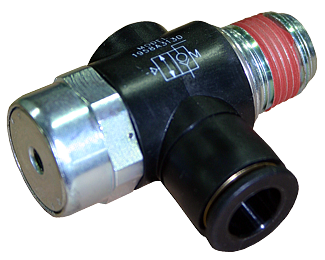




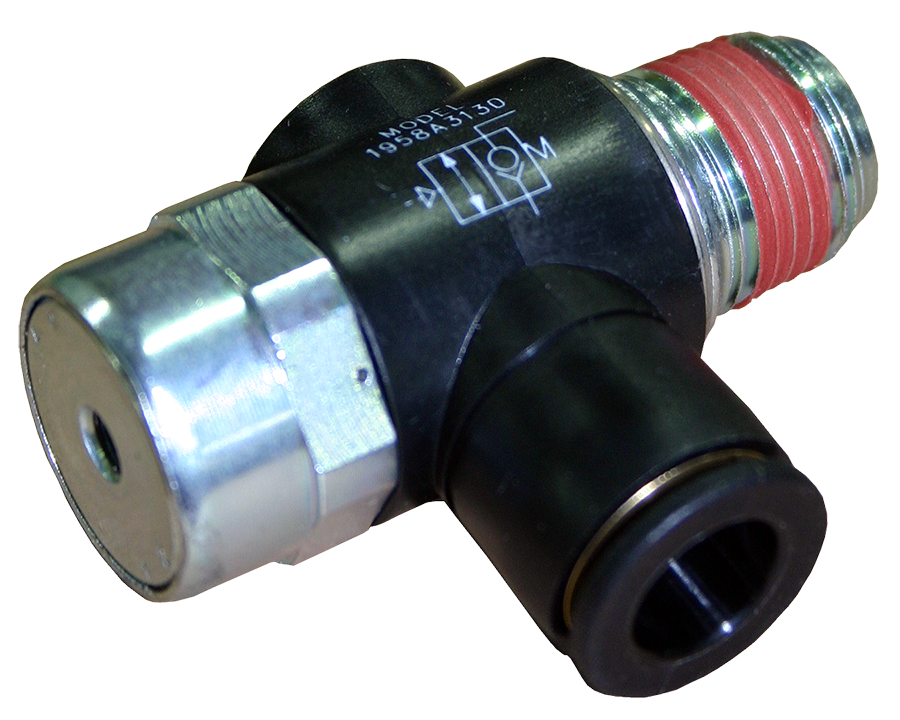
19 Series Pilot Operated Check Valves Safety Category. 1 PL c, Inline mounted, Right Angle
 Product Catalog
- Right-angle design for easy positioning of pipe or tubing
- With Threaded Banjo or Push-to-Connect Fitting
- Lube or non-lube operation
19 Series Pilot Operated Check Valves Product Overview
Pilot Operated Check Valves are used to block the return of air from cylinders or other devices. Air flows freely from port 1 to port 2, but a signal at port 12 is required to allow flow in the reverse direction from port 2 to port 1.
Please refer to the side and below for links to easily navigate and download ROSS Controls 19 Series Pilot Operated Check Valves catalogs, installation instructions, and technical data. Additionally, you have the option to filter through all available options to 19 Series Pilot Operated Check Valves variant that meets your requirements.
loading...
loading...
Product Overview
The ROSS Controls 19 Series Pilot Operated Check Valves are compact, right-angle poppet valves used to block the return of air from cylinders or other pneumatic devices. Air flows freely from port 1 to port 2 under normal supply conditions. A pilot signal at port 12 is required to allow reverse flow from port 2 to port 1. This check action locks pressure in the downstream circuit, enabling load holding and cylinder position holding applications.
The 19 Series uses a right-angle body design that simplifies tubing and pipe routing in confined spaces where a straight-through inline body would require additional elbow fittings. Available fittings include threaded banjo connections and push-to-connect fittings, giving installers flexible tubing interface options without additional adapters. Both lubricated and non-lubricated (lube-free) operation is supported.
The valve body is nickel-plated brass and anodized aluminum, with acetal and stainless steel poppet elements. Dual seal material (Buna-N and Fluorocarbon) provides compatibility across the operating temperature range of 15 to 160 F (-10 to 70 C). Operating pressure range is 5 to 150 psig (0.3 to 10 bar), accommodating both low-pressure pneumatic control circuits and standard 100 psig industrial air systems.
The 19 Series is rated Safety Category 1, Performance Level c (PL c) per ISO 13849-1 and SIL 2 per IEC 61508/IEC 61511. This rating reflects the inherent reliability of the poppet construction and the statistical B10D durability of the valve but does not include integrated position monitoring. For applications requiring Category 2 or higher with position feedback, refer to the SV27 Series pilot operated check valves with DPST switch.
Key Engineering Features
- Right-Angle Body Design - The right-angle port orientation positions pipe or tubing connections perpendicular to the valve body, simplifying installation in panels, manifolds, and enclosures where straight inline mounting would require additional elbows.
- Threaded Banjo or Push-to-Connect Fittings - Available with threaded banjo connections for hard-piped or tubing applications, or with push-to-connect fittings for quick OD tube connections without tools, reducing assembly time in high-density pneumatic panels.
- Lube or Non-Lube Operation - The 19 Series supports both lubricated and non-lubricated compressed air supply, providing flexibility for installation in systems with or without upstream airline lubricators.
- Poppet Construction - Direct-seat poppet design provides near-zero internal leakage and reliable check action, ensuring cylinder pressure is maintained during load holding without continuous air consumption.
- Pilot-Operated Check Function (Port 12) - A pneumatic pilot signal at port 12 opens the check in the reverse direction, allowing controlled pressure release or cylinder retraction. Without a pilot signal, the poppet remains closed under back pressure from the cylinder side.
- Dual Seal Materials (Buna-N and Fluorocarbon) - Both Buna-N and Fluorocarbon seals are incorporated, providing reliable sealing performance across the full temperature range from 15 to 160 F (-10 to 70 C) and compatibility with standard filtered compressed air.
- Nickel-Plated Brass and Anodized Aluminum Body - Corrosion-resistant body materials extend service life in humid and moderately aggressive industrial environments, reducing maintenance frequency and replacement costs.
- Category 1 PL c / SIL 2 Safety Rating - Rated Safety Category 1, PL c per ISO 13849-1 and SIL 2 per IEC 61508/61511, supporting integration into safety-related pneumatic circuits at the Category 1 safety integrity level without external monitoring.
- EAC Declaration of Conformity - EAC declaration is included with the 19 Series, supporting market access in the Eurasian Economic Union (Russia, Kazakhstan, Belarus, and partner states).
- Compact Dimensions - The 19 Series 1/4" port variant measures only 1.7 in (41 mm) in length and 0.5 in (13 mm) in width, enabling installation in tight spaces without sacrificing check valve performance.
Technical Specifications
General Specifications
| Parameter | Specification |
| Series | 19 |
| Valve Function | 2/2 Pneumatic Pilot Operated Check (PO Check) |
| Default State | Normally Closed (check active) |
| Construction | Poppet |
| Actuation | Manual (Pilot Operated via pneumatic signal at port 12) |
| Pilot Type | Air (pneumatic pilot signal) |
| Body Design | Right-Angle, Inline Mounted |
| Port 1 Size (Available) | 1/4" NPT, 6 mm push-to-connect (G thread variant) |
| Port 2 Size (Available) | 1/8" NPT / G |
| Thread Types | NPT and G (BSPP) |
| Fitting Options | Threaded Banjo or Push-to-Connect |
| Operating Pressure | 5 to 150 psig (0.3 to 10 bar) |
| Flow Media | Filtered Air |
| Valve Body Material | Nickel Plated Brass and Anodized Aluminum |
| Poppet Material | Acetal and Stainless Steel |
| Seal Material | Buna-N and Fluorocarbon |
| Mounting | Inline |
Temperature Ratings
Temperature ratings apply equally to ambient and media conditions for all 19 Series variants.
| Configuration | Ambient Temperature | Media Temperature |
| All 19 Series Variants (Buna-N and Fluorocarbon seals) | 15 to 160 F (-10 to 70 C) | 15 to 160 F (-10 to 70 C) |
Flow Performance Data
Flow performance for the 19 Series representative 1/4" port variant (model 1958A1120). Both 1-2 and 2-1 (pilot-opened reverse) flow paths are rated.
| Model | Port 1 Size | Port 2 Size | Ports 1-2 Flow | Ports 2-1 Flow | Length | Width |
| 1958A1120 | 1/4" NPT | 1/8" NPT | 0.4 Cv (394 Nl/min) | 0.4 Cv (394 Nl/min) | 1.7 in (41 mm) | 0.5 in (13 mm) |
| 1958A3130 | 3/8" NPT | 3/8" NPT | 1.2 Cv (1,181 Nl/min) | 1.3 Cv (1,279 Nl/min) | 2.6 in (66 mm) | 1.1 in (27 mm) |
| D1958A1160 | 6 mm (push-to-connect) | 1/8" G | 0.4 Cv (394 Nl/min) | 0.4 Cv (394 Nl/min) | 1.7 in (41 mm) | 0.5 in (13 mm) |
Certifications & Compliance
| Certification/Standard | Detail |
| Safety Category / PL Rating | Category 1, Performance Level c (PL c) per ISO 13849-1, reflecting the inherent reliability of the poppet construction without external monitoring. |
| Safety Integrity Level | SIL 2 per IEC 61508 and IEC 61511, based on the statistical reliability data of the 19 Series poppet design. |
| EAC Declaration | Yes - EAC conformity declaration included, supporting market access in the Eurasian Economic Union. |
| DGUV Certification | No - the 19 Series does not carry DGUV certification. For DGUV-required applications, refer to the SV27 Series. |
| CE Certification | No CE marking on the 19 Series base product. For CE-marked load holding valves, refer to the SV27 Series with DPST switch. |
| CSA/UL Certification | No - not applicable for the 19 Series base product. |
Typical Applications & Industries
Cylinder Position Holding and Load Holding
- Trapping pressure in pneumatic cylinders to hold a cylinder in position when control air is removed, preventing drift caused by external loads, gravity, or vibration in light to medium duty applications.
- Safe return function in pneumatic circuits where a cylinder must remain extended or retracted until a deliberate pilot signal releases the trapped pressure, allowing controlled return.
- Clamp and fixture hold applications in assembly lines where air-powered clamps must maintain grip after the control valve is de-energized, reducing compressed air consumption while maintaining position.
Compact Panel and Manifold Integration
- Panel-mounted pneumatic control systems where the right-angle body reduces the tubing footprint compared to a straight inline valve, particularly useful in multi-circuit manifold assemblies.
- Small-bore cylinder circuits on machine tools, packaging equipment, and material handling systems where compact check valve dimensions minimize panel space requirements.
- Push-to-connect tubing systems where the 19 Series push-to-connect variant eliminates compression fittings and enables faster assembly and disassembly for frequent maintenance.
General Pneumatic Safety Circuits
- Category 1 safety functions per ISO 13849-1 where a single reliable poppet check valve is sufficient to prevent unintended cylinder motion under normal operating conditions.
- Fluid power circuits that require blocking of reverse flow under back pressure conditions, such as counter-balance and anti-drop functions on lightly loaded vertical cylinders.
- Food and beverage processing and pharmaceutical equipment where the non-lube operation option avoids introducing oil contamination into clean-room or hygienic areas.
Ordering and Model Number Configuration
The 19 Series uses a model number structure that encodes port size, thread type, fitting type, and seal material. Contact ROSS Controls at (800) 438-7677 for the full configurator and current pricing. Example model numbers are provided below.
|
19 Series Example Model Number Structure:
1958 A 1 1 20 | | Fitting/Port Option Code | Port Size Code: 1 = 1/4", 2 = 1/4", 3 = 3/8" Seal/Construction Code Revision Level Series: 19 = 19 Series
Prefix D (e.g., D1958A1160) = G (BSPP) thread variant |
NPT thread models use the standard model number prefix (e.g., 1958A1120). G (BSPP) thread models add the prefix 'D' (e.g., D1958A1160).
Push-to-connect variants are available for metric tubing sizes (e.g., 6 mm OD). Contact ROSS Controls for push-to-connect model numbers.
All 19 Series valves include both Buna-N and Fluorocarbon seals as standard, covering the full temperature range of 15 to 160 F (-10 to 70 C).
The 19 Series is available in 1/4" and 3/8" port configurations. For larger port sizes or higher flow requirements, refer to the 27 Series pilot operated check valves.
Accessories
Banjo Fittings and Push-to-Connect Adapters
Threaded banjo fittings and push-to-connect tube fittings are available as factory-installed options on the 19 Series, eliminating the need for separate adapter fittings and reducing installation parts count.
Exhaust Silencers
ROSS aluminum exhaust silencers are available for pneumatic circuit noise reduction. Verify silencer flow capacity equals or exceeds the circuit exhaust flow requirements to avoid back pressure.
Related Products & Accessories
- 27 Series Pilot Operated Check Valves (1305) - Larger-bore inline pilot operated check valves for Category 1 PL c load holding with higher flow capacity and optional pressure relief. https://www.rosscontrols.com/en/series/1305-27-series-pilot-operated-check-valves
- SV27 Series PO Check Valves for External Monitoring (1306) - Pilot operated check valves with integrated DPST safety switch enabling Category 2 PL c load holding with position feedback. https://www.rosscontrols.com/en/series/1306-sv27-series-pilot-operated-check-valves-for-external-monitoring
- SV27 Series PO Redundant Check Valves (1307) - Redundant dual-channel pilot operated check valve assembly with DPST switch for Category 3 PL e load holding. https://www.rosscontrols.com/en/series/1307-sv27-series-pilot-operated-redundant-check-valves
- CC4 Series Double Valve (1303) - 4/3 closed-center double safety directional valve for safe cylinder control and Category 4 PL e load holding. https://www.rosscontrols.com/en/series/1303-cc4-series-double-valve
- Check Valves (Standard) - ROSS standard check valves for non-safety pneumatic circuit backflow prevention applications. https://www.rosscontrols.com/en/series/262-check-valves
Frequently Asked Questions (FAQ)
Q: What is a pilot operated check valve and how does the 19 Series work?
A: A pilot operated check valve allows free flow in one direction (port 1 to port 2) and blocks reverse flow by default. To allow reverse flow from port 2 to port 1, a pneumatic pilot signal must be applied at port 12. In the 19 Series, when pilot pressure is removed, the poppet seats and traps pressure on the port 2 (cylinder) side, holding the cylinder in position.
Q: What is the 19 Series right-angle design advantage?
A: The right-angle body places the port 1 and port 2 connections perpendicular to each other. This eliminates the need for external elbow fittings in panel-mounted applications, reduces the number of potential leak points, and allows more compact installation where a straight inline body would require additional bends in the tubing or piping.
Q: What fitting types are available for the 19 Series?
A: The 19 Series is available with threaded banjo connections and with push-to-connect fittings for OD metric tubing. The push-to-connect variant allows tool-free tube insertion and removal, which simplifies installation and maintenance on high-density pneumatic panels. Contact ROSS Controls for specific push-to-connect model numbers.
Q: What is the operating pressure range?
A: The 19 Series operates from 5 to 150 psig (0.3 to 10 bar). The wide low-end range (starting at 5 psig) makes it suitable for low-pressure pneumatic control circuits, vacuum-adjacent applications, and systems that may see intermittent low-pressure conditions during startup.
Q: What are the temperature limits?
A: The 19 Series is rated for ambient and media temperatures from 15 to 160 F (-10 to 70 C). This covers standard industrial environments and mild cold-climate installations. For extended cold storage below 15 F or elevated temperature above 160 F, consult ROSS Controls for alternative products.
Q: Does the 19 Series support lube-free operation?
A: Yes. The 19 Series is rated for both lubricated and non-lubricated (lube-free) compressed air service. Non-lube operation is particularly valuable in food and beverage, pharmaceutical, and clean-room applications where oil mist from an airline lubricator would be unacceptable.
Q: What safety category and PL does the 19 Series achieve?
A: The 19 Series is rated Safety Category 1, Performance Level c (PL c) per ISO 13849-1 and SIL 2 per IEC 61508/61511. This rating reflects the inherent reliability of the poppet construction without integrated position monitoring. For applications requiring Category 2 or higher with monitoring, specify the SV27 Series.
Q: What certifications does the 19 Series hold?
A: The 19 Series carries an EAC declaration of conformity for Eurasian Economic Union markets. It does not carry DGUV or CE certification. For applications requiring DGUV or CE marking on the load-holding valve, refer to the SV27 Series (Category 2, CE and DGUV certified).
Q: What body and seal materials are used?
A: The body is nickel-plated brass and anodized aluminum. The poppet is acetal and stainless steel. Both Buna-N and Fluorocarbon seals are included as standard, providing reliable sealing performance across the full operating temperature range and compatibility with standard filtered compressed air.
Q: What is the flow capacity of the 19 Series?
A: The 1/4" port variant (model 1958A1120) has a flow of 0.4 Cv (394 Nl/min) in both directions (1-2 and 2-1 pilot-opened). The 3/8" variant (model 1958A3130) has a flow of 1.2 Cv (1,181 Nl/min) in the 1-2 direction and 1.3 Cv (1,279 Nl/min) in the pilot-opened reverse direction. For higher flow requirements, specify the 27 Series.
Q: How is the 19 Series installed in a load-holding circuit?
A: Mount the valve with port 1 connected to the directional control valve (supply/exhaust circuit) and port 2 connected to the cylinder port. Connect port 12 to the pilot signal that commands reverse flow. When the directional valve de-energizes, pilot signal at port 12 is removed, the 19 Series closes, and cylinder pressure is trapped.
Q: Is the 19 Series available with G (BSPP) threads?
A: Yes. G (BSPP) thread variants are designated with the prefix 'D' in the model number (e.g., D1958A1160 for a 6 mm push-to-connect port 1, G 1/8" port 2). Contact ROSS Controls at rosscontrols.com or (800) 438-7677 for the full range of thread and fitting options.
Installation & Maintenance Guidelines
- Mount the 19 Series with port 1 connected to the supply or control valve side and port 2 connected to the cylinder or actuator port. Reverse mounting will result in free flow in the unintended direction.
- Ensure pilot signal port 12 is connected to a pressure source that is reliably removed when load holding is required. The poppet will not close if pilot pressure remains present at port 12.
- Supply filtered compressed air to the 19 Series. A minimum 5-micron filter is recommended upstream to prevent contaminants from depositing on the poppet seat and causing leak-by under load holding conditions.
- Verify supply pressure is within the 5 to 150 psig (0.3 to 10 bar) operating range. Pressures below 5 psig may result in incomplete poppet opening during the supply direction.
- For push-to-connect variants, insert tubing fully until it bottoms in the fitting body. Tug the tubing to confirm engagement. Use the collet release ring to disconnect tubing; never pull tubing without releasing the collet.
- For banjo fitting variants, use a thread sealant compatible with compressed air service on all NPT or G thread connections. Do not over-torque brass threads. Apply torque to the banjo bolt rather than the body to avoid body distortion.
- Confirm the ambient temperature at the installation location is within 15 to 160 F (-10 to 70 C). Do not install in environments below -10 C without reviewing the cold temperature effect on poppet seal flexibility.
- For non-lube (lube-free) operation, ensure no upstream airline lubricator is present or that the lubricator is set to zero output for this circuit branch. Oil contamination from upstream can accelerate seal degradation over time.
- After installation, pressurize the circuit and verify that the valve holds back pressure on the port 2 side with pilot signal removed. Any audible leakage from the cylinder port when the control valve is de-energized indicates a seating problem that must be resolved before the circuit is placed in service.
- Perform a functional test of the pilot release function by applying pilot pressure at port 12 and confirming that back pressure is released from port 2. Confirm that pressure re-traps when pilot signal is removed.
- Do not use the 19 Series as the sole load-holding element in applications requiring Category 2 or higher safety performance without additional monitoring. For monitored load holding, specify the SV27 Series with DPST switch.
- Inspect the valve periodically for external seal wear or body corrosion, especially in high-humidity or washdown environments. Replace seals or the complete valve at the first sign of leakage to prevent cylinder drift in load-holding applications.
Warranty & Global Support
ROSS Controls provides a one-year warranty on all products, covering defects in material and workmanship from the date of purchase.
Global technical support is available through ROSS offices in the USA (headquarters in Ferndale, Michigan), Canada, Brazil, Germany, France, United Kingdom, India, China, and Japan.
Contact ROSS Controls USA at +1-248-764-1800 or toll-free at (800) 438-7677, or visit rosscontrols.com for product configuration, technical support, and distributor locator services.
For complete technical data, dimensional drawings, and valve configurator access, visit the ROSS Controls 19 Series product page at rosscontrols.com or contact ROSS at (800) 438-7677.
Download Catalog: https://www.rosscontrols.com/en/series/1304-19-series-pilot-operated-check-valves
Download Documents
19 Series Pilot Operated Check Valves